"This work is unlike any other, in its range of rich, conjuring imagery and its dexterity, its smart voice. Carroll-Hackett doesn’t spare us—but doesn’t save us—she draws a blueprint of power and class with her unflinching pivot: matter-of-fact and tender." —Jan Beatty
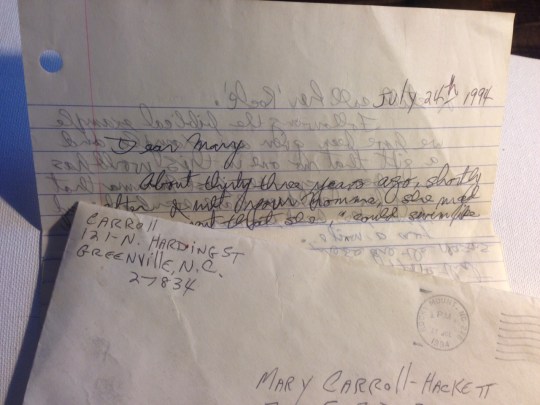
My daddy was a sweet, gentle, and wildly imperfect man. But one thing that we all knew, without question, was how much he loved our mama. And lest we forget, periodically, he would sit down and write a letter to each of us kids, telling us how much, and all the reasons why. We all lived in the same town, for so many years, but these letters would arrive unexpectedly in the mail, missives of fierce and eternal Love.
Make art about an unexpected letter, or about fierce Love.
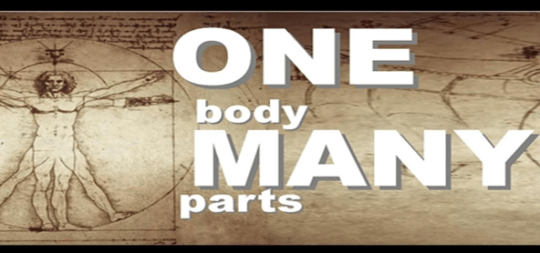
12 There is one body, but it has many parts. But all its many parts make up one body…13 We were all baptized by one Holy Spirit. And so we are formed into one body. It didn’t matter whether we were Jews or Gentiles, slaves or free people. We were all given the same Spirit to drink. 14 So the body is not made up of just one part. It has many parts.
15 Suppose the foot says, “I am not a hand. So I don’t belong to the body.” By saying this, it cannot stop being part of the body. 16 And suppose the ear says, “I am not an eye. So I don’t belong to the body.” By saying this, it cannot stop being part of the body. 17 If the whole body were an eye, how could it hear? If the whole body were an ear, how could it smell? 18 God has placed each part in the body just as he wanted it to be. 19 If all the parts were the same, how could there be a body?20 As it is, there are many parts. But there is only one body.
21 The eye can’t say to the hand, “I don’t need you!” The head can’t say to the feet, “I don’t need you!” 22 In fact, it is just the opposite. The parts of the body that seem to be weaker are the ones we can’t do without. 23 The parts that we think are less important we treat with special honor.–1 Corinthians 12:12-23 New International Reader’s Version (NIRV)
Make art about Connectedness, the inescapability of how we are all connected.
Something a little different this week: recommending a documentary, Poetry of Witness. Poetry of Witness is a 2015 documentary film directed by Billy Tooma and Anthony Cirilo about the lives of six contemporary poets who have lived through, and survived, extremities such as war, torture, exile, and repression, using poetry to preserve their memories.It debuted October 16, 2015 at the Buffalo International Film Festival.
The film documents the struggle of six contemporary poets who have faced the duress of war, exile, and human rights violations to give voice to their experiences while wrestling with the complex moral quandaries of artistic production, memory, and trauma. The poets: Carolyn Forché (Salvadoran Civil War), Saghi Ghahraman (Iranian Revolution), Fady Joudah (Doctors Without Borders), Claudia Serea (Socialist Republic of Romania), Mario Susko (Bosnian War), and Bruce Weigl (Vietnam War) offer first-person accounts of how their experiences as soldier, activist, doctor, and survivor imprint their poetry as evidence of those conflicts, rather than as representations of them.
Award winning poet Carolyn Forché spent 13 years compiling Against Forgetting: 20th Century Poetry of Witness. It is an exhaustive and illuminating work of breadth, beauty, wisdom and tragedy.
The moon does not fight. It attacks no one. It does not worry. It does not try to crush others. It keeps to its course, but by its very nature, it gently influences. What other body could pull an entire ocean from shore to shore? The moon is faithful to its nature and its power is never diminished. -Ming-Dao Deng
I grew up in Hurricane Alley, eastern North Carolina, so the preparation for these big storms is something I learned early. Hurricane Matthew has ripped through Haiti, and is on his way to the US East Coast. All my provisions are laid in, flashlights and emergency equipment in place and ready, and I’ve battened down as much as I can. But sometimes Mama Nature’s just too big and unpredictable for any kind of preparation.
Make art about preparing the best you can.
10/5/2016
Thinking a lot today about all the ways people find their way to, or demonstrate faith. Took me immediately to one of my top three favorite songs, The Mountain, by Dave Carter and Tracy Grammer.
Excerpted Lyrics by Dave Carter
Some build temples and some find altars, some come in tall hats and robes spun fine. Some in rags, some in gemstone halters, some push the pegs back in line.
I see the mountain, the mountain comes to me, I see the mountain and that is all I see.
Make art about temples or altars or shrines, faith in some unexpected way.
10/6/2016
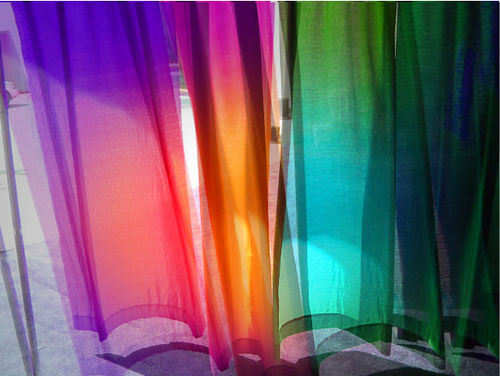
Road Angel Andrea at Walmart today told me about her grandmama teaching her to sew, first by making curtains, long straight hems, she said, over and over again, summer curtains, winter curtains with their heavy lining. She said her grandmama was patient but tough, making her tear out crooked stitches, and try again til she got it right. “I learned to take my time,” she said. “I learned to take my time, look ahead of the foot, and how a pair of curtains can make all the difference in a room.”
Make art about curtains. Or about what you learned from an elder.
The most recent book from one of my always favorite poets, Pattiann Rogers.
Ms. Rogershas published eleven books of poetry; two book-length essay collections, The Dream of the Marsh Wrenand The Grand Array; and A Covenant of Seasons, poems and monotypes, in collaboration with Joellyn Duesberry. She is the recipient of two NEA grants, a Guggenheim Fellowship, and a Lannan Literary Award for poetry. She lives in Colorado.
“I believe Pattiann Rogers walks the world at night when we are sleeping. Her poems are translations of our dreaming life—what we know to be true but fail to remember. We read her words, sentence by sentence, image by image, and return to all that is beautiful, mysterious, and erotic.” —Terry Tempest Williams
“Pattiann Rogers is a visionary of reality, perceiving the material world with such intensity of response that impulse, intention, meaning, interconnections beyond the skin of appearance are revealed. Her language, unmarred by clichés, springs up out of a sense of how various and endlessly amazing are the forms of life and the human ability to notice them.” —Denise Levertov
“How the densely detailed, thickly textured, imaged stanzas of Pattiann Rogers result in so much light-as-air wonderment is surely one of the greater questions—one of the greater magics—of contemporary poetry. But however it happens, we must be thankful—for both the science text and the psalter of her work, for both the physical abundance and for the spirit flimmering over it.” —Albert Goldbarth
 Something a little different this week: recommending a documentary,

 Ms. Rogers
 Mary Carroll-Hackett: Poetry and Prose
Recent Comments