Daily Prompt Catch-Up <3 Falling, Rising
27 May 2017
Make art about struggling with depression.
28 May 2017
Make art about learning how to rise from the ashes.

27 May 2017
Make art about struggling with depression.
28 May 2017
Make art about learning how to rise from the ashes.
26 May 2017
In The Citizen’s Handbook, Charles Dobson talks at length about what he call harmonizers: a facilitator whose main job will be to encourage people with different views to listen to the other, and ask questions, rather than trying to score points.”
Make art about harmonizers, about creating or fostering harmony, about harmony through compromise.

25 May 2017
Been reading and thinking a lot lately about vintage sewing, about work done by hands in the countless generations before me.
Make art about feeling connected to something from another era, another time. Reveal this connection through a specific daily process or specific object.


24 May 2017
“When someone steals another’s clothes, we call them a thief. Should we not give the same name to one who could clothe the naked and does not? The bread in your cupboard belongs to the hungry; the coat unused in your closet belongs to the one who needs it; the shoes rotting in your closet belong to the one who has no shoes; the money which you hoard up belongs to the poor.” ― Basil of Caesarea
Make art about thieves, thievery, about thefts of the spirit.
23 May 2017
Make art about seeing the world through eyes of Love, especially when it seems most impossible.

22 May 2017
Thanks and Love to that fabulous poet-sister Amy Tudor for posting the article that inspires today’s prompt.
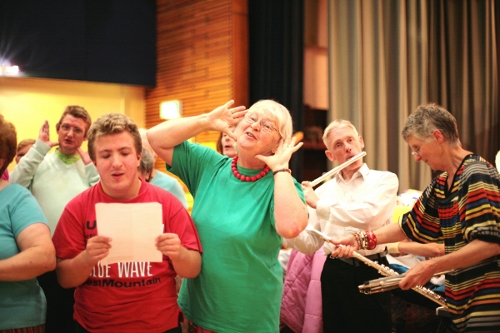
“Adults in America don’t sing communally. Children routinely sing together in their schools and activities, and even infants have sing-alongs galore to attend. But past the age of majority, at grown-up commemorations, celebrations, and gatherings, this most essential human yawp of feeling—of marking, with a grace note, that we are together in this place at this time—usually goes missing.”
How Communal Singing Disappeared From American Life: And Why We Should Bring It Back
Make art about singing with others, about that joining of voices.
The wonderful Robert S. King and Diane Kistner at FutureCycle Press are launching a new journal: Good Works Review, now open for submissions.
From the website:
“Submissions to our first issue are now open (see guidelines) for poetry, short fiction, literary essays, and black-and-white artwork. We will not publish online but in an annual printed issue along with a Kindle e-book version, usually in December of each year.
Like Kentucky Review, this new publication is part of FutureCycle Press’s Good Works Projects. All proceeds from sales of GWR are donated to the ACLU.
Website: http://goodworksreview.futurecycle.org/
Guidelines: https://futurecycleflash.submittable.com/submit
20 May 2017
Sewing without a pattern, a night gown I’ve wanted to attempt for months, but kept scaring myself out of trying.
Make art about attempting something you’ve been scared to try.

21 May 2017
Make art about making moments of peace among the tumult.

19 May 2017
Seven years ago today, my oldest son J was in a terrible car accident, his little plastic Saturn sedan t-boned by a brand new Dodge Charger with its all-steel construction.
J, my laughing, charismatic, kind, smart son, only 22 then, was critically injured, with a compression skull fracture, subdural hematoma, subarachnoid hemorrhaging, and four feather bleeds into his beautiful brain. They airlifted him by helicopter from our small town to the major medical facility, MCV, in Richmond, admitting him directly into the neurological ICU. He was conscious the whole time, talking, joking, charming the nurses, complaining that he couldn’t look out the window on his first-ever helicopter ride, even saying things meant to reassure me, his sister, his brother, the friends who stood by us at the hospital. We bedded down in the ICU waiting room, while behind those heavy doors, monitors clicked and hummed, documenting my son’s traumatic brain injury. That was Wednesday.
Early Thursday afternoon, as I stood as J’s bedside, a doctor we hadn’t seen before strode in, his crisp white lab coat flowing behind him. He introduced himself as the head of neurological research, and after a moment, he asked us if we had seen J’s latest CT scan. We hadn’t, so he hurried from the room, telling us he’d be right back. J and I looked at each other, confused, and my son must have seen worry in my eyes, as he patted my hand.
The doctor returned, wheeling in a large piece of equipment, a medical imaging viewer, and positioned it at the end of J’s ICU bed. He turned it on and the image of my son’s skull appeared, stark in the black and whiteness of it all. For a second, we were completely silent. Then the doctor, smiling, began to explain what we were seeing.
What we were seeing was nothing: no bleeding, no bruising, no swelling. The only sign that remained of my son’s injury just 24 hours before was the spiderweb of fractures in the bone, as if a pencil eraser had been pushed into the fragile shell of an egg, a network of bone break just beneath the C-shaped wound on the side of his head. J’s brain looked completely normal, showing not a single other sign of the blow he’d taken the day before in the wreck that had left his little car mangled, left nothing but the driver’s seat intact.
The doctor grinned, saying, “We want to study you, study why and how you healed so quickly.”
That was Thursday. We brought J home midday on Friday. Six weeks later, he was back at work, then back to his last year of college that fall. We talked time and again about his miraculous healing, about why it might have happened.
J, my wise son, said, “Mom, I don’t know why it happened. I just know I got another chance.”
He now calls May 19 his birthday. His Facebook status this morning read, “Today, I am alive.”
Make art about being given another chance.
 Mary Carroll-Hackett: Poetry and Prose
Recent Comments