"This work is unlike any other, in its range of rich, conjuring imagery and its dexterity, its smart voice. Carroll-Hackett doesn’t spare us—but doesn’t save us—she draws a blueprint of power and class with her unflinching pivot: matter-of-fact and tender." —Jan Beatty
Al Maginnes is the author of seven full length collections and four chapbooks of poems, most recently The Next Place (Iris Press, 2017). He lives in Raleigh, North Carolinaand teaches at Wake Technical Community College. His poems and reviews have appeared widely. He is music editor for Connotations Press and a member of Liberty Circus, a music and spoken word collective dedicated to raising money for those who work with immigrants and other forms of social justice.
Poets Against the War: The Movement, The Anthology
Led by poet Sam Hamill, February 12, 2003 became a day of Poetry Against the War conducted as a reading at the White House gates in addition to over 160 public readings in many different countries and almost all of the 50 states. Since then, over 9,000 poets have joined this grassroots peace movement by submitting poems and statements to http://www.poetsagainstthewar.org, registering their opposition to the Bush administration’s headlong plunge toward war in Iraq. Poets Against the War features a selection of the best poems that were submitted to the website. Contributors include: Adrienne Rich, W.S. Merwin, Galway Kinnell, Robert Bly, Marilyn Hacker, Grace Schulman, Shirley Kaufman, Wanda Coleman, Yusef Komunyakaa, Hayden Carruth, Jane Hirshfield, Tess Gallagher, Sandra Cisneros, former Poet Laureate Rita Dove, and many others.
from Citizen, VI [On the train the woman standing]
Claudia Rankine
On the train the woman standing makes you understand there are no seats available. And, in fact, there is one. Is the woman getting off at the next stop? No, she would rather stand all the way to Union Station.
The space next to the man is the pause in a conversation you are suddenly rushing to fill. You step quickly over the woman’s fear, a fear she shares. You let her have it.
The man doesn’t acknowledge you as you sit down because the man knows more about the unoccupied seat than you do. For him, you imagine, it is more like breath than wonder; he has had to think about it so much you wouldn’t call it thought.
When another passenger leaves his seat and the standing woman sits, you glance over at the man. He is gazing out the window into what looks like darkness.
You sit next to the man on the train, bus, in the plane, waiting room, anywhere he could be forsaken. You put your body there in proximity to, adjacent to, alongside, within.
You don’t speak unless you are spoken to and your body speaks to the space you fill and you keep trying to fill it except the space belongs to the body of the man next to you, not to you.
Where he goes the space follows him. If the man left his seat before Union Station you would simply be a person in a seat on the train. You would cease to struggle against the unoccupied seat when where why the space won’t lose its meaning.
You imagine if the man spoke to you he would say, it’s okay, I’m okay, you don’t need to sit here. You don’t need to sit and you sit and look past him into the darkness the train is moving through. A tunnel.
All the while the darkness allows you to look at him. Does he feel you looking at him? You suspect so. What does suspicion mean? What does suspicion do?
The soft gray-green of your cotton coat touches the sleeve of him. You are shoulder to shoulder though standing you could feel shadowed. You sit to repair whom who? You erase that thought. And it might be too late for that.
It might forever be too late or too early. The train moves too fast for your eyes to adjust to anything beyond the man, the window, the tiled tunnel, its slick darkness. Occasionally, a white light flickers by like a displaced sound.
From across the aisle tracks room harbor world a woman asks a man in the rows ahead if he would mind switching seats. She wishes to sit with her daughter or son. You hear but you don’t hear. You can’t see.
It’s then the man next to you turns to you. And as if from inside your own head you agree that if anyone asks you to move, you’ll tell them we are traveling as a family.
Michael Meyerhofer is a contemporary poet and fantasy author who believes those two genres genuinely can get along. To illustrate this, his debut fantasy novel, Wytchfire (Book I in the Dragonkin Trilogy), was published by Red Adept Publishing, and went on to win the Whirling Prize and a Readers Choice nomination from Big Al’s Books and Pals. The sequels, Knightswrath and Kingsteel, are out now. He is also the author of the forthcoming Godsfall Trilogy. Michael’s fourth poetry book, What To Do If You’re Buried Alive, was published by Split Lip Press. His third, Damnatio Memoriae (lit. “damned memory”), won the Brick Road Poetry Book Contest. His previous books are Leaving Iowa (winner of the Liam Rector First Book Award) and Blue Collar Eulogies (Steel Toe Books, finalist for the Grub Street Book Prize).
He has also published five poetry chapbooks: Pure Elysium (winner of the Palettes and Quills Chapbook Contest), The Clay-Shaper’s Husband (winner of the Codhill Press Chapbook Award), Real Courage (winner of the Terminus Magazine and Jeanne Duval Editions Poetry Chapbook Prize), The Right Madness of Beggars (winner of the Uccelli Press 3rd Annual Chapbook Competition), and Cardboard Urn (winner of the Copperdome Chapbook Contest).
Michael has won the Marjorie J. Wilson Best Poem Contest, the Laureate Prize for Poetry, the James Wright Poetry Award, and the Annie Finch Prize for Poetry. His work has appeared in Ploughshares, North American Review, Arts & Letters, River Styx, Quick Fiction, Asimov’s Science Fiction Magazine, and other journals.
He received his BA from the University of Iowa and his MFA from Southern Illinois University Carbondale. An avid weightlifter, medieval weapons collector, and unabashed history nerd, he currently lives, teaches, and inhabits various coffee shops around Fresno, CA.
“With a compassionate eye, and his trademark sense of humor that hooks readers from the very first page, Meyerhofer sends us back to our earliest memories, and shows us a world of heartbreak and wonder.” -Mary Biddinger, author of A Sunny Place with Adequate Water
“…Meyerhofer sings in a pure American tenor, his voice haunted by late night diners, small town heartbreak, and somehow, out there in the desolate vastness of the heartland, a flash of humor and a sweet glimmer of hope.” -George Bilgere, author of Imperial
“While never flinching from confronting the irredeemable damage we do to one another, these urgent and necessary poems remind us ‘that if we focus on what hurts, / face it wholly, it dissolves / like a light from a burnt-out bulb, / a curtain gone up in flames.” -Jon Tribble, author of Natural State
The fabulous and loving Nancy Peacock is the author of the novels Life Without Waterand Home Across the Road, as well as the memoir, A Broom of One’s Own: Words on Writing, Housecleaning, and Life. She currently teaches writing classes and workshops in and around Chapel Hill, North Carolina, where she lives with her husband Ben.Her most recent novel, The Life and Times of Persimmon Wilson is a definite must read!
“ ‘I have been to hangings before, but never my own…’ From this riveting beginning to the last perfect word, Nancy Peacock grabs her reader by the throat and makes him hang on for dear life as the action moves from a Louisiana sugar plantation to life among the western Comanches, bringing to blazing life her themes of race and true love caught in the throes of history. The Life and Times of Persimmon Wilsonis as deeply moving and exciting an American saga as has ever been penned.” -Lee Smith, Author of Guests on Earth and Dime Store
“Such a powerful story, so beautifully written. Peacock captures the era perfectly, with just the right amount of historical detail woven seamlessly into the fabric of the story. Unlike some historical novels loaded with digressions that are merely undigested chunks of raw research, this book is just the opposite—a fully realized world with rich, vivid characters. The novel hard to put down—and impossible to forget.” Donna Lucey – author of Sargent’s Women: Four Lives Behind the Canvas
“A magnificent, immersive, breathtaking work of historical fiction. Nancy Peacock has written a beautifully crafted, richly detailed novel inhabited by morally complex and fully realized characters, enthralling and heartbreaking in equal measure.” -Jennifer Chiaverini – author of Mrs. Lincoln’s Dressmaker
Resist Much, Obey Little: Inaugural Poems to the Resistance
A monumental anthology of poems of resistance, edited by Michael Boughn, John Bradley, Brenda Cardenas, Lynne DeSilva-Johnson, Kass Fleisher, Roberto Harrison, Kent Johnson, Andrew Levy, Nathaniel Mackey, Ruben Medina, Philip Metres, Nita Noveno, Julie Patton, Margaret Randall, Michael Rothenberg, Chris Stroffolino, Anne Waldman, Marjorie Welish, Tyrone Williams.
Featuring poetry by Eileen Myles, Nathaniel Mackey, Anne Waldman, Margaret Randall, Forrest Gander, Rachel Blau DuPlessis, Brenda Hillman, Bob Holman, Pierre Joris, Douglas Kearney, Evie Shockley, & Terese Svoboda, Norma Cole, Fady Joudah, Lewis Warsh, and more.
50% of the proceeds will be donated to Planned Parenthood.
we can’t build a wall. we can only spout pure water again and again and drown his lies.~Eileen Myles
Racism, xenophobia, misogyny and their related malaises are to the U.S. what whiskey is to an alcoholic. The current occupant of the White House won the election yipping, against possible recovery, “Drinks are on me!” The rich, multitudinous voices in this anthology variously call for—having embarked on—the hard work of sobriety, sanity.~Nathaniel Mackey
Poets are summoned to a stronger imagination of language and humanity in a time of new and radical Weathers. White House Inc. is the last gasp of the dying Confederacy, but its spectacle is dangerous and addictive so hold onto your mind. Fascism loves distraction. Keep the world safe for poetry. Open the book of love and resistance. Don’t tarry!~Anne Waldman
On April 20, 2010, nine Latino students chained themselves to the main doors of the Arizona State Capitol in an act of civil disobedience to protest Arizona’s SB 1070. Moved by the students’ actions, that same day Francisco X. Alarcón responded by writing a poem in Spanish and English titled “Para Los Nueve del Capitolio/ For the Capitol Nine,” which he dedicated to the students. The students replied to the poem with a collective online message. To share with the world what was taking place, Alarcón then created a Facebook page called “Poets Responding to SB 1070” and posted the poem, launching a powerful and dynamic forum for social justice.
Since then, more than three thousand original contributions by poets and artists from around the globe have been posted to the page. Poetry of Resistanceoffers a selection of these works, addressing a wide variety of themes, including racial profiling, xenophobia, cultural misunderstanding, violence against refugees, shared identity, and much more. Contributors include distinguished poets such as Francisco Aragón, Devreaux Baker, Sarah Browning, Lorna Dee Cervantes, Susan Deer Cloud, Sharon Dubiago, Martín Espada, Genny Lim, Pam Uschuk, and Alma Luz Villanueva.
Bringing together more than eighty writers, the anthology powerfully articulates the need for change and the primacy of basic human rights. Each poem shows the heartfelt dedication these writers and artists have to justice in a world that has become larger than borders. Poetry of Resistance is a poetic call for tolerance, reflection, reconciliation, and healing.
Praise for Poetry of Resistance
Poetry of Resistance is a timely response (via verse) to the current political climate of Arizona, though what the book ultimately argues is that these injustices have always been taking place—SB 1070 is simply its most recent manifestation. —Rigoberto González, author of Our Lady of
Alarcón and co-editor the eco-poet and activist Odilia Galván Rodríguez selected the strongest work from the hundreds of entries to shape this anthology whose communal message—a plea for social change—will remain timeless and resonant.–NBC News
The beautiful Naomi Ayala was born in Puerto Rico and moved to the United States in her teens, eventually earning an MFA from the Bennington College Writing Seminars. Writing in both Spanish and English, she is author of the poetry collections Wild Animals on the Moon, chosen by the New York City Public Library as a 1999 Book for the Teen Age, This Side of Early, and this week’s recommended read, Calling Home:Praise Songs and Incantations. Her poems have appeared in the anthologies Boriquén to Diasporican: Puerto Rican Poetry from Aboriginal Times to the New Millennium (2007), Latino Boom: An Anthology of U.S. Latino Literature (2006), and First Flight: 24 Latino Poets (2006).
An educator and arts administrator interested in environmental causes, Ayala has received numerous awards, including the Connecticut Latinas in Leadership Award, the 2000 Dr. Martin Luther King Jr. Legacy of Environmental Justice Award, and the 2001 Larry Neal Writers Award for Poetry from the DC Commission on the Arts and Humanities.
Ayala has been a visiting humanities scholar for Hermana a Hermana/Sister to Sister and was co-chair of the board of directors for the organization Change: Building Social Justice, Starting in the Classroom; she co-founded the New Haven Alliance for Arts and Cultures. A former resident of Washington, DC, she currently lives in New Haven, Connecticut, and works as a freelance writer, educational consultant, and teaching artist.
This week meet one of my most beloved brother mans 🙂 Peter Grandbois, author of seven books, including: The Gravedigger, selected by Barnes and Noble for its “Discover Great New Writers” program, The Arsenic Lobster: A Hybrid Memoir, chosen as one of the top five memoirs of 2009 by the Sacramento News and Review, Nahoonkara, winner of the gold medal in literary fiction in Foreword magazine’s Book of the Year Awards for 2011, a collection of surreal flash fictions, Domestic Disturbances, a finalist for Book of the Year in Foreword magazine’s 2013 awards, and the novella collections or “monster double features,” Wait Your Turn, The Glob Who Girdled Granville (Honorable Mention, IndieFab award in the category of best fantasy of 2014), and The Girl on the Swing. His essays and short stories have appeared in numerous journals and been shortlisted for both the Pushcart Prize and Best American Essays. His plays have been performed in St. Louis, Columbus, Los Angeles, and New York. He is senior editor at Boulevard magazine and fiction co-editor at Phantom Drift.
Peter is a graduate of the University of Denver (Ph.D. 2006) and Bennington College (M.F.A. 2003). Previously, he taught at California State University in Sacramento and is currently an associate professor at Denison University.
Nahoonkara is my favorite 🙂
Praise for Nahoonkara
In the tradition of nature writers Rick Bass and Annie Dillard, award winning writer Peter Grandbois’ new novel Nahoonkaraopens up an oneiric space of wonder, a place outside preconceived notions of reality and identity, a place where we are free to re-imagine ourselves.
“[Nahoonkara]…incorporates elements of historical fiction with experimental fiction, but nothing that pulls the reader out of the fictional dream.”
—Robin Martin,Gently Read Literature
“Departing from traditional narrative form, Grandbois moves masterfully between first, second, and third persons to invite readers into a textual visualization of how individual choices affect the well-being of the community.” —Review of Contemporary Fiction
“Peter Grandbois is a splendid writer I intend to follow very closely.”
—Robert Olen Butler, Pulitzer Prize Winning author of A Good Scent From a Strange Mountain
“Vividly drawn, exquisitely crafted, Nahoonkara bespeaks not just the promise of its author, but also his undeniable power.”—Laird Hunt, author of Ray of the Star
And we’re back—with the amazing Gabrielle Brant Freeman, author of the stunning debut collection When She Was Bad. Gabrielle’s poetry has been published in many journals, most recently in Barrelhouse, Hobart, Melancholy Hyperbole, Rappahannock Review, storySouth, and Waxwing. She was nominated twice for the Best of the Net, and she was a 2014 finalist. Gabrielle won the 2015 Randall Jarrell Poetry Competition. Press 53 published her first book, When She Was Bad, in 2016. Gabrielle earned her MFA through Converse College.
Lust. Love. Betrayal and loyalty. Temptation and hilarity. Gabrielle Freeman dissects her speakers’ hearts, tenderly, with supreme attention to what it is to be human, female, and fierce. Gabrielle Freeman’s poems are bad–by which I mean badass bold. Michael Jackson bad. Freeman’s bad and you know it. That’s why you read her. When She Was Bad is a smart, compassionate, tightly crafted and explosive debut. — Denise Duhamel
 Al Maginnes is the author of seven full length collections and four chapbooks of poems, most recently The Next Place (Iris Press, 2017). He lives in Raleigh, North Carolina and teaches at Wake Technical Community College. His poems and reviews have appeared widely. He is music editor for Connotations Press and a member of Liberty Circus, a music and spoken word collective dedicated to raising money for those who work with immigrants and other forms of social justice.

 Michael Meyerhofer is a contemporary poet and fantasy author who believes those two genres genuinely can get along. To illustrate this, his debut fantasy novel, Wytchfire (Book I in the Dragonkin Trilogy), was published by Red Adept Publishing, and went on to win the Whirling Prize and a Readers Choice nomination from Big Al’s Books and Pals. The sequels, Knightswrath and Kingsteel, are out now. He is also the author of the forthcoming Godsfall Trilogy.
 The fabulous and loving Nancy Peacock is the author of the novels Life Without Water and Home Across the Road, as well as the memoir, A Broom of One’s Own: Words on Writing, Housecleaning, and Life. She currently teaches writing classes and workshops in and around Chapel Hill, North Carolina, where she lives with her husband Ben. Her most recent novel, The Life and Times of Persimmon Wilson is a definite must read!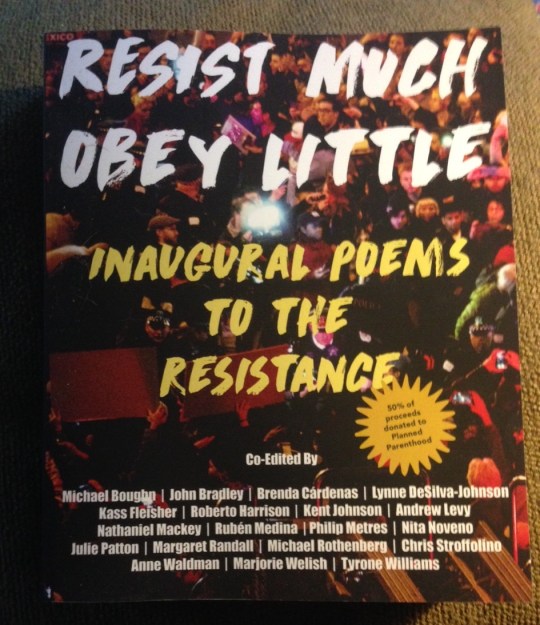
 Poetry of Resistance: Voices for Social Justice
 The beautiful
  This week meet one of my most beloved brother mans 🙂 Peter Grandbois, author of seven books, including: The Gravedigger, selected by Barnes and Noble for its “Discover Great New Writers” program, The Arsenic Lobster: A Hybrid Memoir, chosen as one of the top five memoirs of 2009 by the Sacramento News and Review, Nahoonkara, winner of the gold medal in literary fiction in Foreword magazine’s Book of the Year Awards for 2011, a collection of surreal flash fictions, Domestic Disturbances, a finalist for Book of the Year in Foreword magazine’s 2013 awards, and the novella collections or “monster double features,” Wait Your Turn, The Glob Who Girdled Granville (Honorable Mention, IndieFab award in the category of best fantasy of 2014), and The Girl on the Swing. His essays and short stories have appeared in numerous journals and been shortlisted for both the Pushcart Prize and Best American Essays. His plays have been performed in St. Louis, Columbus, Los Angeles, and New York. He is senior editor at Boulevard magazine and fiction co-editor at Phantom Drift.
 And we’re back—with the amazing Gabrielle Brant Freeman, author of the stunning debut collection When She Was Bad. Gabrielle’s poetry has been published in many journals, most recently in Barrelhouse, Hobart, Melancholy Hyperbole, Rappahannock Review, storySouth, and Waxwing. She was nominated twice for the Best of the Net, and she was a 2014 finalist. Gabrielle won the 2015 Randall Jarrell Poetry Competition. Press 53 published her first book, When She Was Bad, in 2016. Gabrielle earned her MFA through Converse College.
  Mary Carroll-Hackett: Poetry and Prose
Recent Comments